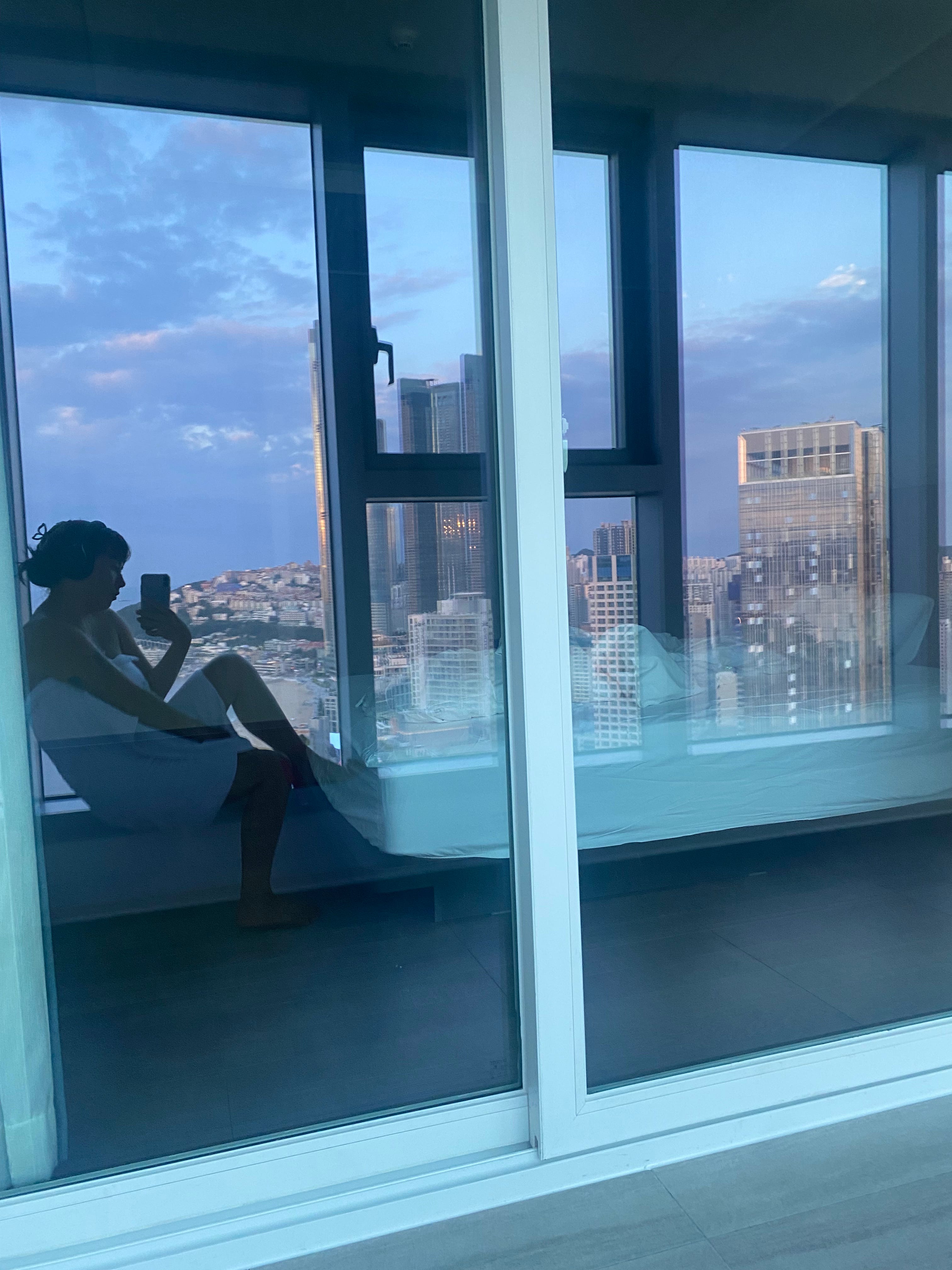
Staring straight down the barrel of forever
a meditation on time in Korea

I’m in Seoul. It’s 4:32 AM. Truth be told, I love jet lag. I love the feeling of being awake when no one else is. I remember those late December’s in Saskatchewan at my great grandmother’s house when I was a kid. Still on Hong Kong time, I would crawl out of bed in the basement and wander up stairs. I would pad around on the carpeted flooring, my footsteps muffled, in a complete circle from the kitchen, to the dining area, to the living room and back again, as the old grandfather clock ticked on. In the middle of the night, the house that was so familiar now seemed strange and foreign, as if I was seeing it for the very first time. The clock droned on, and there basked in the light of the open refrigerator, I could feel the weight of time. I would lie down, on that beige carpet as time stretched out, vast and impossibly large.
I would have nightmares about the bigness of things as a kid. Nightmares about multiplying large numbers. In one, I had to bury sausages in the ground, but there were simply too many of them, far more than I could possibly bury, infinite piles. Yes, I’m sure Freud would have a field day with that one. I would wake from these dreams in a cold sweat, shaking and scared. When I would wake up my parents, it would be hard to relay these dreams. As soon as I would voice the contents of them, I would immediately feel foolish. I did not have enough vocabulary to describe the feeling of it. How this meaningless task I was given was infinite. That it was Sisyphus rolling a rock up a hill. There was no completion, I was staring straight down the barrel of forever.
I’m on a train to Busan. I can’t believe how many mountains there are, 70% of the Korean Peninsula, CJ told us. They don’t jut up into jagged peaks, but round and roll like gigantic hills. When we were heading into Seoul from the airport, I was moved to tears seeing them for the first time. It surprised me, because I have given up a homecoming fantasy about the motherland™ for some time now. It was maybe because of this, in the void of such fantasies, that I could access something that was less grand, but more honest. I felt it, whatever “it” is, maybe a simple awe at the grandeur of these ancient mountains, maybe something more.
I tell my dad that he is Scarlett Johansson in Lost in Translation. I mean this as a good thing, but I’m not sure if it’s received as such. He is in a foreign city with a spouse that is often away working long hours. He is not sure what his purpose is here, in Seoul. He takes the train to the coast. He visits a Buddhist temple. He goes to Korean classes in the morning and ponders what to do with the rest of the day. He figures out how to put enough Korean together to get a haircut at the barber. He feels bored, lonely sometimes, and often aimless.
There is a soft spot in my heart that is reserved only for my father. His shame, I feel as my own. It churns through me. I test out various states of “healthy” emotional distance, but it takes only one passing comment from him and I’m punctured all over again. I have no good defense for how deeply it crushes me when he puts himself down. I want to take his whole life here and hold it in my hands, charging it with a kinder narrative that has more space in it, more space for him to exist. Yes, it would be like a Sofia Coppola film, long shots of staring out train windows and vast cityscapes. Time shifts ambiently and it is only sometimes oppressive, but through a beautiful lens, it becomes suffused with a dream-like quality. So much time and nothing to do with it, a gilded cage, the constraints of such luxury. Here there is nowhere to hide from yourself, and maybe that’s the whole point. But I can’t do that, impart a narrative on someone else as if they were a projector screen. Because really it’s quite selfish, just a way to spare my heart the pain of it.
I think I’m trying to talk about time, the weight of it. Sheila Heti said on a podcast once, that women move through time and men move through space. God might not be a woman, but time sure is. Like a woman, she’s a shapeshifter taking on whatever role that is prescribed to her. How does that Lorde song go? She’s been the prize, the ball, the chain. She’s been the dice, the magic eight. She’s been the siren, been the saint. She’s been the fruit that leaves a stain.
Time has been a great many things for me. It has been a knife at my throat, something always at risk of being wasted, a prized possession, fungible, something that could be added up and divided. In that sense, it was an object of sorts. When touched gently, it changes shape, pulsing with the most subtle glow. This summer I had nothing to say, and so I did not force it. Time then seemed like a mountain, large, unmoveable, and comforting. And then, as the summer cooled down, it was like a mist, suffused and everywhere.
I could tell you the exact moment when I felt my brain chemistry change around time. I was walking on the high line to the free sunday at the Whitney. I was late for my time slot. As I weaved in and out of crowds periodically checking my phone, it occurred to me that I could just… stop. It always seems to work like that. All that turmoil and suffering, so many years of rushing against the current of time that was always moving faster than I could grab at it, journal entries upon journal entries bemoaning all the time I was wasting. Then, one day, it’s right there in front of my face, clear and simple, so obvious. I was not beholden to time, but in relationship to it. I had the capacity to change its shape. Did it really matter that I was 10 minutes late to my free time slot or was I manufacturing some feeling of urgency because….? I find it hard to write about moments like this. It risks bordering on impossibly simple, trivial even. How could I tell you that something so small felt like a brush with enlightenment? I walked slower, observing the people around me, the scenery, the moment. Time was everywhere, it was glowing.
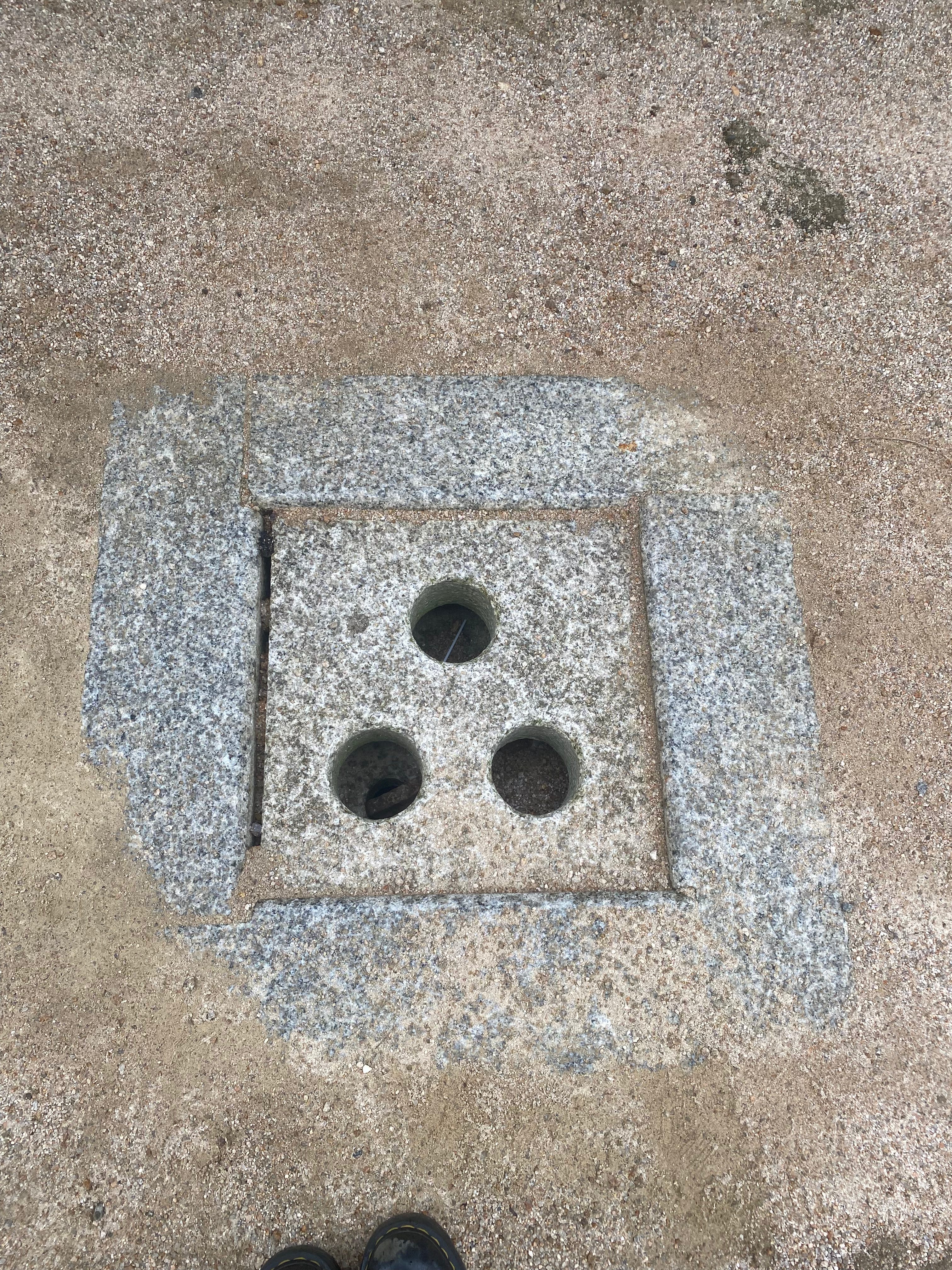
Simone Weil said “Time is an image of eternity, but it is also a substitute for eternity.” Time is both real and unreal. The future and even the past exists more in the realm of imagination, of fantasy, than of reality. As an image, or imagination, it offers a projection of the eternal. It is finding a video you made at ten on an old camcorder, burying your childhood dog in your backyard, finding your great grandmother’s teenage scrapbook where she laments about the girl that stole her boyfriend. For a moment, the processes of change, of birth and decay are not abstract. The narrative is poignant. Here is the proof, that your great great great great grandmother was a teenage girl too, that some unrecalled past is a part of your present in unseen ways. You might even consider descendants and the innumerable artifacts they will have from you, sexy bikini poses on the internet, more photos than we even know what to do with, hopefully something analog as well, embarrassing journal entries, old love letters. There it is eternity laid out flat, backwards and forwards.
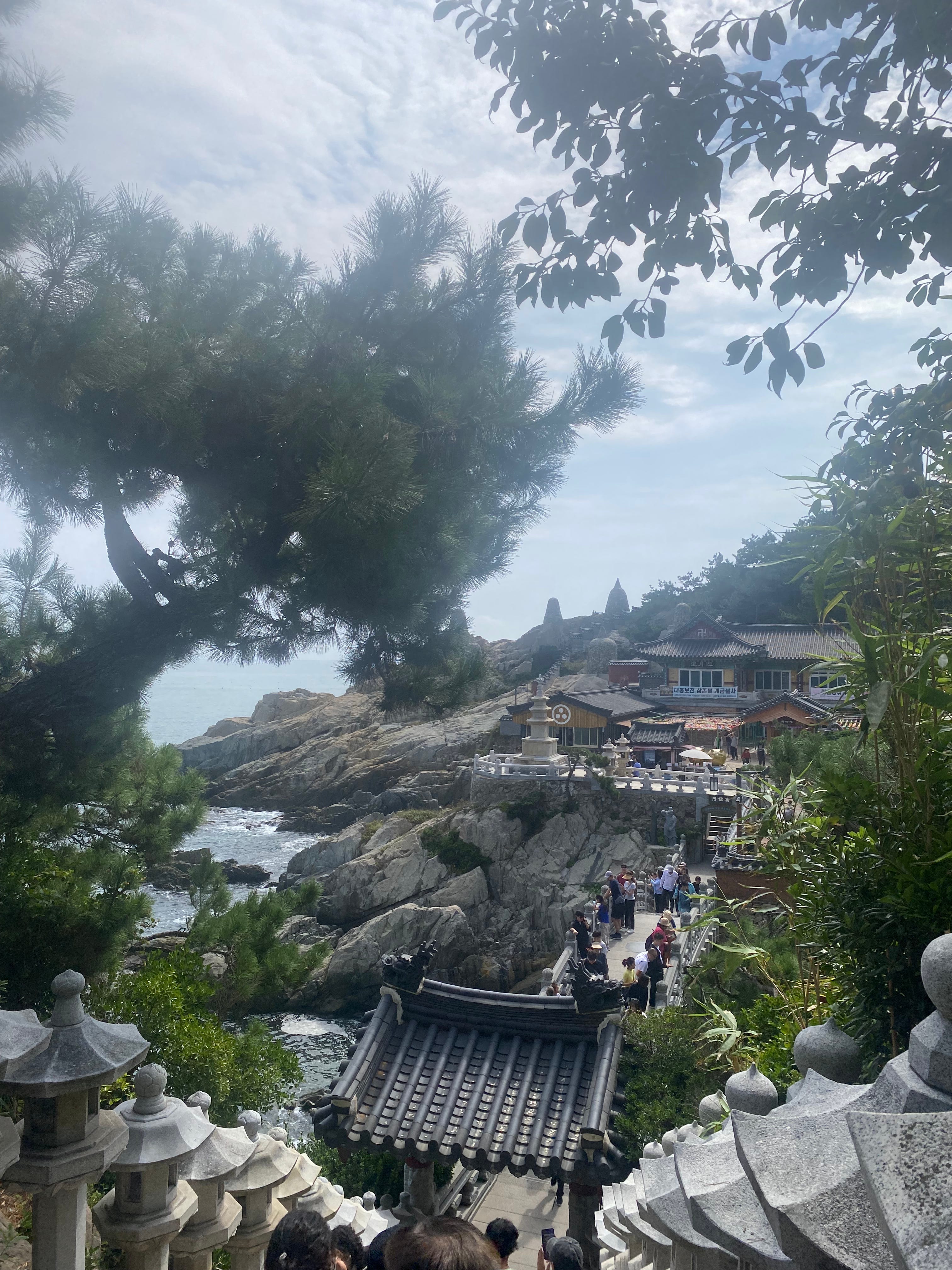
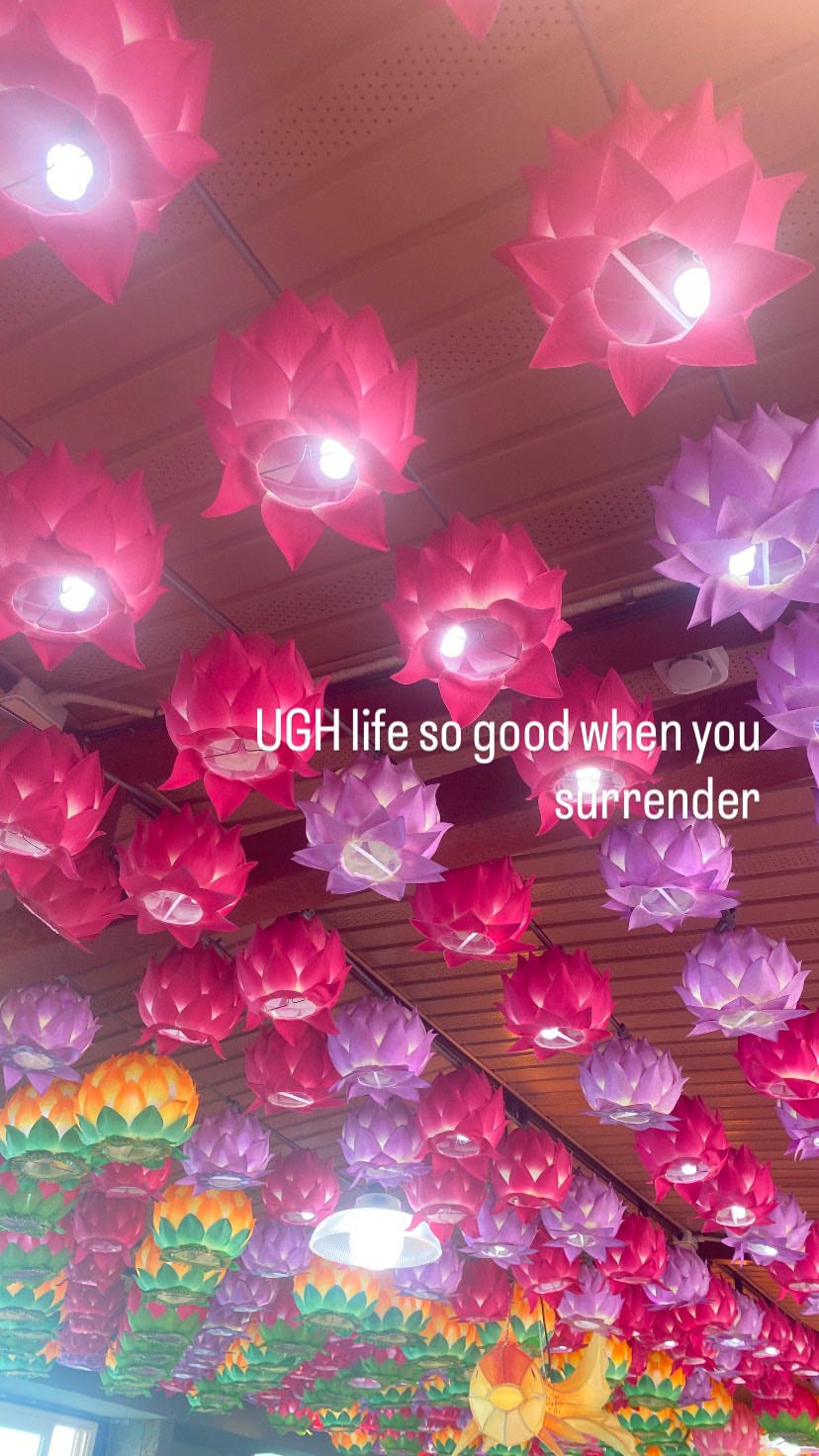
But eternity is not a straight line, nor an image, it is something else entirely. On the phone with Adjo, I said that I didn’t think I could have come to Korea at any other time. I had planned an exchange five years ago that got derailed by you-know-what. Then, I wanted eternity laid out backwards. It was that connection to home, the weight of a past that was recognizable to me as my own that I coveted like treasure. I had photos of the mountains, the ocean pasted in a journal, long letters to an imagined home. At a Buddhist temple in Busan, nestled where the mountains meet the sea, I considered that that past was not mine to have. [ ] In fact, there was something else, the ocean breeze, saying thank you in earnest, God all around. I felt it, the weight of time, the eternity of now, staring straight down the barrel of forever.
-Thai x
playing in a record store in Itaewon: